How Long Does Customs Clearance Take in Cyprus?
One of the most common questions importers ask before a shipment arrives is: how long does customs clearance take in Cyprus? The honest answer is that it depends — but for most standard commercial shipments with complete documentation, clearance at Limassol Port or Larnaca Airport takes between one and five working days from the time the customs declaration is submitted.
The key variable is not the port itself, but the state of the documentation and whether the shipment is selected for physical examination. A well-prepared consignment with all required documents submitted before arrival will clear significantly faster than one where documents arrive piecemeal after the cargo is already in the port.
This guide explains the typical clearance timelines for different shipment types, the main factors that affect how long the process takes, and what you can do to ensure your goods clear as quickly as possible.
Typical Customs Clearance Timelines in Cyprus
The table below shows indicative clearance timelines for different shipment types under normal conditions, assuming complete documentation is submitted on time. These are working-day estimates and do not account for public holidays or periods of unusually high port congestion.
| Shipment Type | Port / Airport | Typical Clearance Time | Notes |
|---|---|---|---|
| General commercial cargo (FCL) | Limassol Port | 1–3 working days | From declaration submission |
| General commercial cargo (LCL) | Limassol Port | 2–4 working days | Includes deconsolidation time |
| Air freight (standard) | Larnaca Airport | 1–2 working days | Faster than sea freight |
| Air freight (express/courier) | Larnaca Airport | Same day – 1 working day | Subject to document readiness |
| Perishable goods | Limassol / Larnaca | Same day – 1 working day | Prioritised by customs |
| Personal effects / household goods | Limassol Port | 2–5 working days | Depends on inventory and permits |
| Vehicles | Limassol Port | 2–5 working days | Includes type approval checks |
| Restricted / controlled goods | Any | 5+ working days | Additional permits required |
These timelines assume that all required documents are submitted before or immediately upon the shipment’s arrival. Delays in document submission are the single most common reason clearance takes longer than expected.
Step-by-Step Customs Clearance Process in Cyprus
Understanding the customs clearance process step by step helps importers plan their logistics and identify where delays are most likely to occur. The following is the standard sequence for importing goods into Cyprus from a non-EU country:
Step 1 — Arrival of Cargo. The vessel or aircraft arrives at Limassol Port or Larnaca Airport. The shipping line or airline files a manifest with Cyprus Customs, listing all consignments on board. For sea freight, an Entry Summary Declaration (ENS) must be submitted electronically before arrival.
Step 2 — Manifest Submission and Processing. The carrier's manifest is processed by the port or airport authority and matched against pre-arrival declarations. This typically occurs within hours of arrival.
Step 3 — Import Declaration (SAD). Your licensed customs broker in Cyprus submits the electronic import declaration — known as the Single Administrative Document (SAD) or IM4 — through the Cyprus eCUSTOMS system. The declaration includes the HS tariff code, customs value, country of origin, and the customs procedure requested.
Step 4 — Customs Risk Analysis. The eCUSTOMS system automatically assigns a risk channel to the declaration:
- Green channel: The declaration is accepted and the goods are released without further checks. This is the fastest outcome.
- Yellow channel: A documentary check is required. Customs officers review the submitted documents for accuracy and completeness.
- Red channel: A physical examination of the goods is required. This adds 1–3 additional business days to the clearance process.
Step 5 — Duty & VAT Payment. Once the declaration is accepted, the system calculates the Cyprus import duty and VAT payable. Payment must be made before the goods are released, unless the importer holds a customs deferment account.
Step 6 — Cargo Release. After duties are paid and any examinations completed, Cyprus Customs issues the release order. The goods can then be collected from the port or airport warehouse.
Limassol Port Customs Clearance
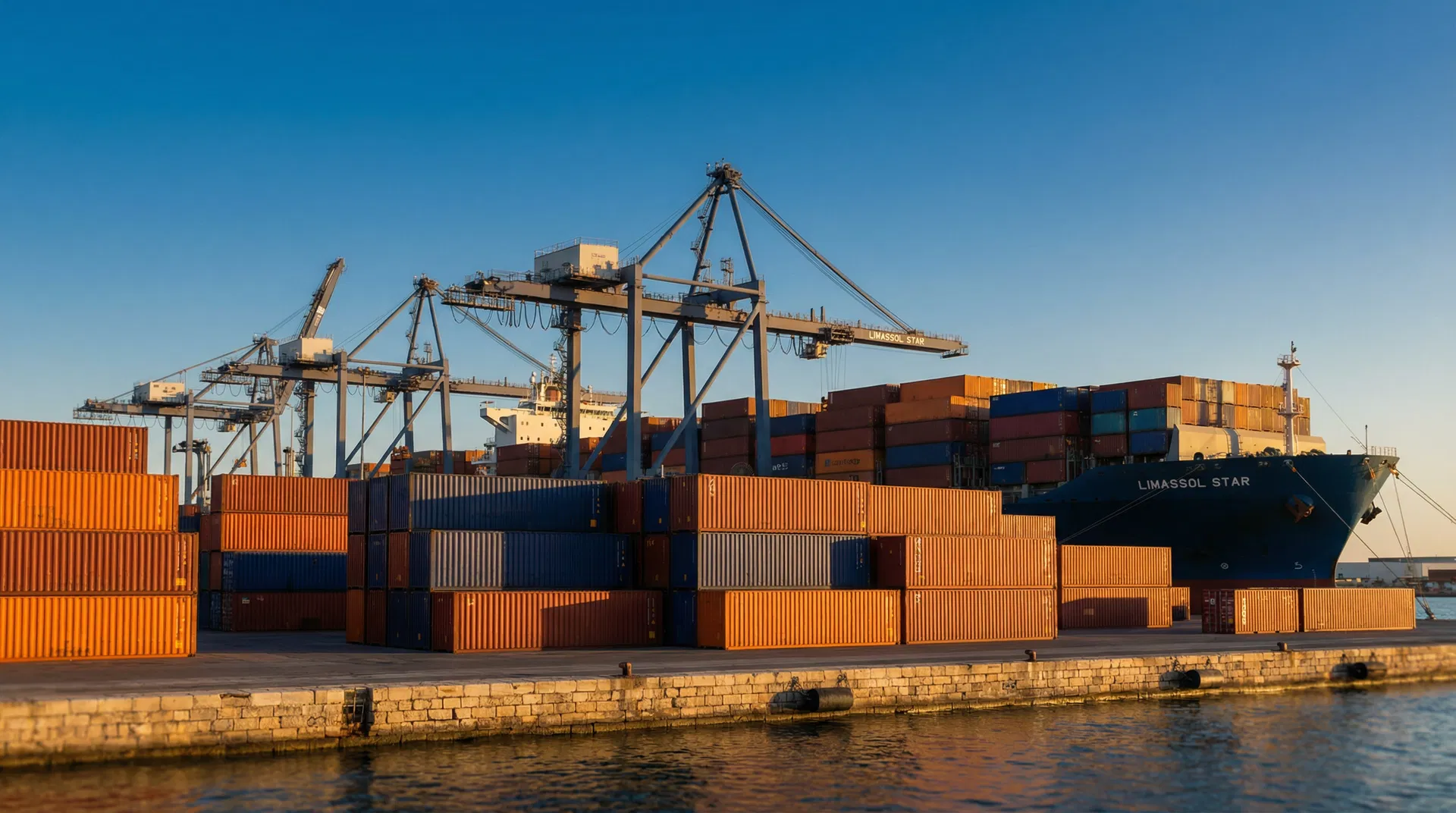
Limassol Port is the main commercial port of Cyprus and handles the vast majority of the island's sea freight imports. Operated by DP World, the port is connected to major shipping routes across the Mediterranean, Europe, Asia, and the Middle East.
For standard commercial containers arriving at Limassol Port, the typical customs clearance time is 1–3 business days from submission of a complete import declaration. The process begins when the vessel berths and the containers are discharged. Your customs broker can pre-lodge the declaration before the vessel arrives, which significantly reduces the time between discharge and release.
Factors that affect clearance time at Limassol Port include:
- Whether the declaration is pre-lodged or submitted after arrival
- The risk channel assigned by the eCUSTOMS system
- Whether the goods require inspection by other authorities (veterinary, phytosanitary, health)
- The accuracy of the commercial invoice and HS classification
- Port congestion during peak periods
Larnaca Airport Customs Clearance
Air freight customs clearance is handled at Larnaca International Airport, which serves as the primary air cargo hub. Customs clearance for air freight at Larnaca Airport is generally faster than sea freight, with typical processing times of 1–2 business days.
The faster turnaround is partly due to the smaller volume of individual consignments and the streamlined handling procedures at the air cargo terminal. Express courier shipments (DHL, FedEx, UPS) may clear within the same day, as these operators have pre-established electronic connections with Cyprus Customs.
However, the same documentation requirements apply to air freight as to sea freight. A complete commercial invoice, air waybill, packing list, and any required certificates must be submitted with the import declaration. Missing documents will delay clearance regardless of the entry point.
5 Factors That Affect Customs Clearance Time in Cyprus
1. Documentation Completeness
The customs declaration cannot be submitted until all required documents are available. For most commercial shipments, this means the commercial invoice, packing list, Bill of Lading or Air Waybill, and a valid EORI number. If any of these are missing, incorrect, or inconsistent with each other, the declaration will be held pending correction. This is the most common source of avoidable delay.
2. Physical Examination
Cyprus Customs uses a risk-based system to select shipments for physical examination. When a shipment is selected, customs officers inspect the cargo to verify that it matches the declaration. Physical examinations add time — typically one to two additional working days — and require the broker to be present at the port. Having a broker with physical presence at Limassol Port means examinations can be attended promptly rather than scheduled around travel time.
3. Restricted or Controlled Goods
Certain categories of goods require additional permits, licences, or certificates before customs will release them. This includes pharmaceuticals, medical devices, food products requiring health certificates, weapons and dual-use goods, and goods subject to CITES regulations. If these permits are not obtained before the shipment arrives, clearance will be delayed until they are in place. A customs broker experienced in your commodity type will identify these requirements in advance.
4. EORI Number Validity
All commercial importers in Cyprus must hold a valid EORI number to submit a customs declaration. If your EORI number is not yet registered, or if there are issues with the registration, the declaration cannot be submitted. EORI registration in Cyprus typically takes a few working days — it should be completed well before your first shipment arrives.
5. Port Congestion and Seasonal Peaks
Limassol Port handles a significant volume of cargo, and congestion during peak periods — particularly in the summer months and around major holidays — can extend clearance times. This is largely outside the importer’s control, but working with a broker who has established relationships at the port can help ensure your shipment is processed efficiently even during busy periods.
How to Speed Up Customs Clearance in Cyprus
The most effective way to ensure fast customs clearance is to prepare documentation before the shipment departs. The following checklist covers the key actions:
- Obtain your EORI number before your first import — do not wait until the shipment is en route.
- Prepare the commercial invoice with the correct buyer/seller details, accurate description of goods, HS codes, and declared value.
- Ensure the packing list matches the invoice exactly — discrepancies between the two are a common trigger for examination.
- Obtain the Bill of Lading or Air Waybill from the carrier as early as possible and share it with your customs broker immediately.
- Identify any restricted goods in your shipment and obtain the necessary permits before departure.
- Engage your customs broker early — ideally before the shipment departs — so they can review documents and flag any issues while there is still time to correct them.
For time-sensitive shipments, our same-day customs clearance service at Limassol Port and Larnaca Airport is available when all documentation is in order. Contact us in advance to discuss whether same-day clearance is achievable for your cargo.
Example: Realistic Timeline for a Container from China
To illustrate how the process works in practice, consider the following example of a standard 40ft container of consumer electronics shipped from Shenzhen, China to Limassol Port, Cyprus:
| Stage | Timeline |
|---|---|
| Vessel arrives at Limassol Port | Day 0 (Monday) |
| Container discharged and manifest processed | Day 0 – Day 1 |
| Import declaration (SAD) submitted by customs broker | Day 1 (pre-lodged before arrival) |
| eCUSTOMS risk analysis — assigned green channel | Day 1 (automated, within minutes) |
| Import duty (3.7%) and VAT (19%) calculated and paid | Day 1 |
| Customs release order issued | Day 1 |
| Container collected from port terminal | Day 2 (Tuesday) |
In this example, the total clearance time from vessel arrival to cargo collection is approximately 2 business days. The key factor enabling this fast turnaround is the pre-lodging of the declaration and the completeness of the documentation. Had the shipment been assigned to the red channel for physical examination, an additional 1–3 business days would have been required.
For a complete overview of the import process, including documentation and duty calculations, see our guide on how to import goods into Cyprus. If you are importing a car to Cyprus, the timeline and procedures differ — consult our dedicated vehicle import guide.
How a Customs Broker Affects Clearance Speed
The choice of customs broker has a direct impact on how quickly your goods clear. A broker with physical presence at Limassol Port can submit declarations immediately upon document receipt, attend physical examinations without scheduling delays, collect release orders in person, and respond to customs queries in real time. A broker operating remotely introduces additional time at each of these steps.
P. Panagi & Sons Ltd is based at Limassol Port. We have been handling customs clearance at this port for over 40 years, and our team attends examinations, collects release orders, and liaises directly with customs officers on-site. For importers where speed matters, this physical presence is a practical advantage.
For a broader overview of what a customs broker does and when you need one, see our guide: Why You Need a Customs Broker in Cyprus.
Conclusion
Customs clearance in Cyprus takes between one and five working days for most standard commercial shipments — but the actual time depends almost entirely on documentation readiness and whether the shipment is selected for examination. Preparing all required documents before the shipment arrives, holding a valid EORI number, and working with a broker who has direct port presence are the three most effective ways to minimise clearance time.
If you have an upcoming shipment and want to understand the clearance timeline for your specific cargo, contact P. Panagi & Sons Ltd. We will advise on the documents required, the expected clearance timeline, and any additional requirements for your commodity type.
P.Panagi & Sons Ltd is a licensed customs clearing and forwarding agent based at Limassol Port, Cyprus, with over 40 years of experience in import and export customs clearance.
Frequently Asked Questions
For standard commercial shipments with complete documentation, customs clearance at Limassol Port typically takes one to three working days from the time the declaration is submitted. Shipments selected for physical examination or those with documentation issues may take longer. Same-day clearance is possible for urgent shipments when all documents are prepared and submitted in advance.
Air freight customs clearance at Larnaca Airport is generally faster than sea freight, often completed within one to two working days for standard commercial shipments. Express and courier shipments may clear the same day if documentation is in order. Perishable goods and time-sensitive cargo are prioritised.
The most common causes of customs clearance delays in Cyprus are incomplete or incorrect documentation, missing or invalid EORI numbers, goods selected for physical examination by customs officers, restricted or controlled goods requiring additional permits, and high port congestion periods. Preparing all required documents before the shipment arrives is the most effective way to avoid delays.
Same-day customs clearance in Cyprus is possible in certain circumstances — particularly for air freight at Larnaca Airport and for urgent shipments at Limassol Port where all documentation is complete and submitted before arrival. Our team can prioritise urgent clearances when required. Contact us in advance of your shipment’s arrival to discuss whether same-day clearance is achievable for your specific cargo.
Yes. A licensed customs broker with physical presence at the port or airport can submit declarations promptly, respond to customs queries in real time, attend physical examinations, and collect release orders without delay. Brokers who operate remotely or without direct port access introduce additional time at each of these steps. P. Panagi & Sons Ltd is based at Limassol Port, which means we can act immediately when customs requires a response.
Need Help with Customs Clearance in Cyprus?
Our licensed customs agents at Limassol Port handle import clearances for businesses and individuals every day. Contact us for a fast, transparent, and professional service.